Missing SMSF Deeds: The Hidden Risk Most People Don’t See
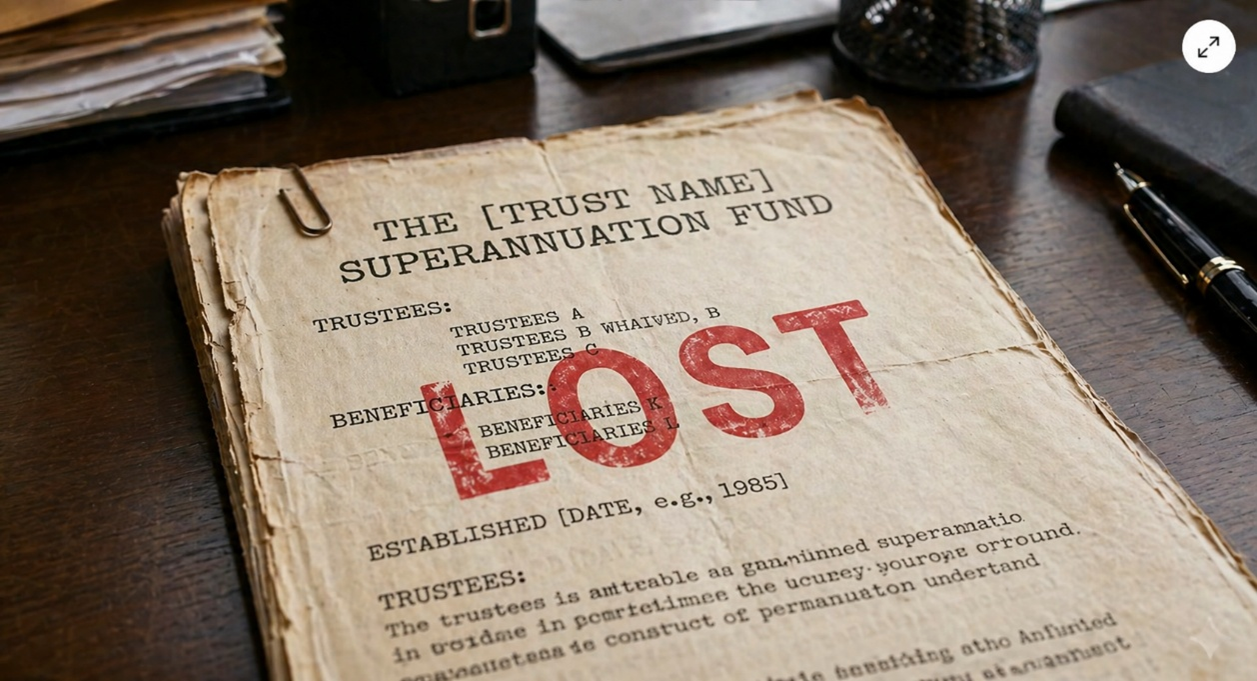
Most people never imagine their super fund ending up in court. It feels like something that only happens to others, not to everyday families who are simply trying to manage their finances and plan for the future.
But that’s exactly what happened in one real case.
The SMSF had been around for decades. It was set up back in 1979, long before digital records and cloud storage. Over the years, the fund moved through different stages of life. Trustees changed. Companies were updated. Documents were added along the way. Like many long-running funds, it just kept going.
On the surface, everything looked fine. The fund had assets. Members were receiving benefits. Returns were being lodged each year. There were no obvious red flags.
Then one simple question came up.
“Where is the original trust deed?”
That question changed everything.
When they started looking for the documents, they found pieces of the story, but not the full picture. Some records were there, but key documents were missing. Certain amendments from earlier years could not be located. Trustee changes had happened, but not every step could be clearly proven. The fund had a long history, but the legal trail behind it had gaps.
Because of this, the matter ended up in court.
The court was faced with a difficult situation. On one hand, the paperwork was incomplete. On the other hand, the fund had been operating for many years and appeared to be functioning properly. It held assets. It supported its members. It looked like a valid structure.
Instead of unraveling decades of activity, the court took a practical approach. It accepted that since the fund had been running for so long without issue, it was reasonable to assume that things were likely done correctly at the time. It also recognised that the entity acting as trustee had been managing the fund for years, even if the original appointment could not be perfectly proven.
This allowed the fund to continue operating.
At first glance, that outcome might sound reassuring. It might feel like a safety net is in place if documents go missing.
But the reality is very different.
The court’s decision was not a solution. It was a fallback. It was used because there was no better option. The past was not fixed. The gaps were still there.
This is where the real risk lies.
When documents are missing or incomplete, you are relying on assumptions instead of certainty. If a trustee was not properly appointed, there may be questions about who legally controls the assets. If records are not clear, there may be compliance issues. These problems often stay hidden for years, only to surface when it matters most.
That moment usually comes at the worst time. It could be when someone passes away, when assets need to be distributed, or when a dispute arises within a family. What once seemed like a small documentation issue can quickly become a major legal problem.
This is why it is so important not to rely on what “seems fine.”
A fund can look healthy on the surface while carrying hidden risks underneath.
The only way to truly understand your position is to go back to the beginning. You need to know where the trust started, who had the authority to make changes, and whether each step along the way was properly documented. Every amendment, every trustee change, and every restructure needs to be clear and supported.
If even one part of that chain is missing, there is a potential risk.
An SMSF is more than just a structure on paper. It holds your retirement savings. It supports your future and, in many cases, your family’s future as well.
If the foundation is unclear, everything built on top of it becomes uncertain.
The key takeaway is simple.
If you don’t know where your trust started, you don’t fully know what you have today.