13-week cash flow forecast: spot cash gaps before they hit
Your business has work coming in. Customers owe you money. Sales look healthy.
Yet wages fall due on Thursday, a supplier needs payment on Friday, and your biggest customer won’t pay until next month.
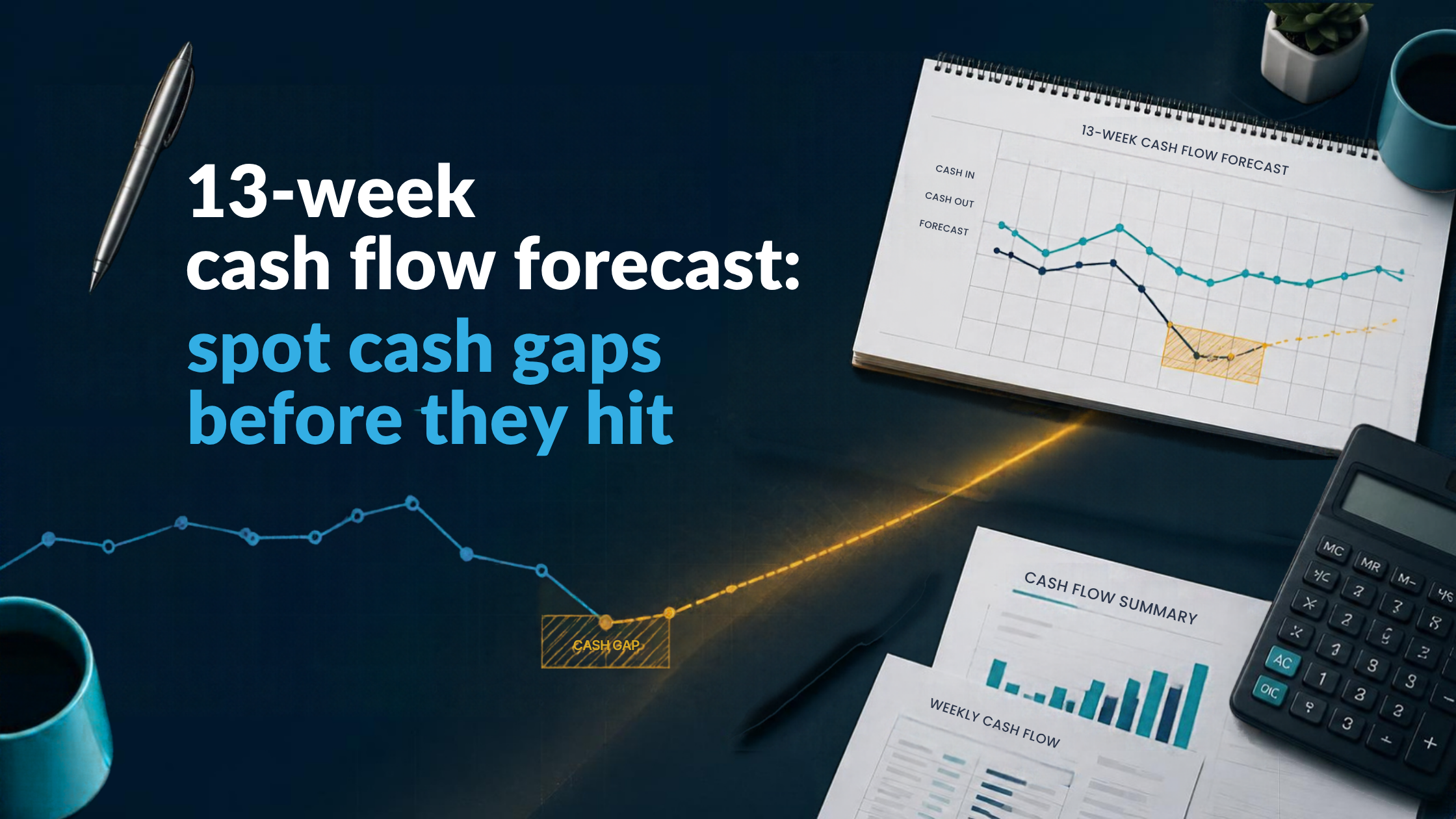
A 13-week cash flow forecast helps you see those timing gaps earlier. It maps the money you expect to receive and spend each week, giving you a clearer view of when cash could become tight.
For business owners managing growth, payroll, and competing commitments, that visibility supports a practical question: What do we need to do now to meet the payments ahead?
What is a 13-week cash flow forecast?
A 13-week cash flow forecast estimates your weekly cash movements over roughly three months. You update it regularly so it continues to look 13 weeks ahead.
It focuses on when money enters or leaves your bank account. An invoice you issue today might not provide cash for several weeks.
The Australian Government explains that cash flow forecasting can help businesses anticipate shortages and plan payments. Its guidance also recommends clearly identifying estimates and whether figures include GST. Business.gov.au: Set up a cash flow statement
The weekly calculation is straightforward:
Opening cash + expected receipts − expected payments = closing cash
Each week’s closing cash becomes the following week’s opening cash.
The 13-week format offers a useful planning window. It is a management tool, not a statutory reporting requirement.
What should your forecast include?
Start with your available business cash, outstanding invoices, supplier bills, payroll schedule, and upcoming commitments.
Use actual expected payment dates wherever possible.
|
Forecast item |
What to include |
|
Opening cash |
Cash available at the start of the week. Identify restricted funds separately. |
|
Expected receipts |
Customer payments and other inflows you reasonably expect that week. Show any funding separately from trading receipts. |
|
Wages and superannuation |
Net wages and superannuation payments on their expected payment dates. |
|
Tax payments |
BAS, PAYG, income tax, and other applicable payments, using confirmed amounts or clearly labelled estimates. |
|
Supplier payments |
Bills, materials, stock, and contractor payments according to agreed terms. |
|
Other payments |
Rent, insurance, subscriptions, loan repayments, equipment purchases, and owner withdrawals. |
|
Closing cash |
The amount remaining after the week’s expected inflows and outflows. |
Keep the treatment consistent. If you enter net wages, include the related PAYG withholding payment separately when you expect to remit it. Avoid counting it twice.
For a bank-based forecast, include GST in customer and supplier cash movements where applicable, then separately schedule the expected BAS payment or refund. Ask your accountant to check the treatment.
A worked 13-week cash flow forecast example
Imagine a fictional service business with $30,000 in opening cash.
It expects regular customer receipts, weekly payroll outflows, supplier bills, and an $18,000 tax payment in week four.
For this simplified example:
- All figures below represent AUD thousands: 30 means $30,000.
- Receipts and supplier payments include GST where applicable.
- “Payroll” combines net wages and superannuation cash payments.
- “Other” combines remaining operating payments.
- The tax amount and timing are hypothetical, not a tax calculation or deadline.
- The business has no other cash movements or available borrowing facility.
|
Week |
Opening cash |
Receipts |
Payroll |
Tax |
Suppliers |
Other |
Closing cash |
|
1 |
30 |
22 |
9 |
0 |
10 |
3 |
30 |
|
2 |
30 |
24 |
9 |
0 |
11 |
3 |
31 |
|
3 |
31 |
20 |
9 |
0 |
10 |
3 |
29 |
|
4 |
29 |
30 |
9 |
18 |
12 |
3 |
17 |
|
5 |
17 |
18 |
9 |
0 |
10 |
3 |
13 |
|
6 |
13 |
24 |
9 |
0 |
11 |
3 |
14 |
|
7 |
14 |
22 |
9 |
0 |
12 |
3 |
12 |
|
8 |
12 |
26 |
9 |
0 |
10 |
3 |
16 |
|
9 |
16 |
24 |
9 |
0 |
11 |
3 |
17 |
|
10 |
17 |
22 |
9 |
0 |
10 |
3 |
17 |
|
11 |
17 |
28 |
9 |
0 |
12 |
3 |
21 |
|
12 |
21 |
24 |
9 |
0 |
11 |
3 |
22 |
|
13 |
22 |
26 |
9 |
0 |
12 |
3 |
24 |
In week four, the calculation is:
$29,000 + $30,000 − $9,000 − $18,000 − $12,000 − $3,000 = $17,000
The business stays cash-positive throughout the forecast. However, its balance falls to $12,000 in week seven.
Suppose the owner chooses a minimum cash buffer of $15,000. The forecast falls below that buffer in weeks five, six, and seven.
That buffer is an internal planning choice. The right amount depends on the business’s commitments and exposure to uncertainty.
Downside scenario: a customer pays three weeks late
Now assume a customer delays a $20,000 payment from week four to week seven. All other assumptions remain unchanged.
Week-four receipts fall from $30,000 to $10,000. Week-seven receipts rise from $22,000 to $42,000.
|
Week |
Base forecast closing cash |
Closing cash after delay |
What changes |
|
4 |
$17,000 |
−$3,000 |
The first funding gap appears. |
|
5 |
$13,000 |
−$7,000 |
The gap reaches its largest week-end amount. |
|
6 |
$14,000 |
−$6,000 |
The shortfall continues. |
|
7 |
$12,000 |
$12,000 |
The delayed payment arrives. |
The business still ends week 13 with $24,000. But it cannot make every scheduled payment along the way without taking action.
A healthy closing balance three months from now can hide a cash shortage next month.
Here, negative figures represent an unfunded requirement, not an assumed overdraft. The owner needs at least $7,000 of additional cash or agreed changes to payment timing to avoid a negative week-end balance. Maintaining the chosen $15,000 buffer would require a $22,000 improvement at the lowest point.
Check daily movements around tight weeks, too. Payments can fall due before receipts arrive, even when the week ends positive.
What decisions does the forecast support?
Which customer payments need attention?
Identify receipts that have the greatest effect on your cash position. Confirm expected payment dates, resolve invoice disputes, and follow up before a delay becomes urgent.
Business.gov.au recommends improving invoicing and collections, reviewing costs, and testing cash flow changes before acting. Business.gov.au: Improve your cash flow
Can you afford the next commitment?
Add a proposed hire, equipment purchase, or larger stock order to the forecast. Check the lowest cash balance as well as the ending balance.
For the example business, a $10,000 equipment payment in week five would reduce that week’s base closing cash to $3,000.
That gives the owner a reason to review timing, alternatives, and the remaining cash buffer before committing.
Do you need to discuss payment terms or funding?
An early warning gives you time to discuss revised terms with suppliers or assess suitable funding.
Only reflect changed payment terms once the relevant party agrees. Keep unapproved finance separate from your base forecast, and include repayments, interest, and fees when testing a funding option.
Can the business fund new work?
A new contract may require wages and materials well before the customer pays. Model those outflows alongside realistic receipt dates.
The forecast helps you assess the cash needed to deliver the work, even when the contract appears profitable.
Keep the forecast useful with a weekly review
Give one person responsibility for maintaining the forecast and set a regular review with the owner or decision-maker.
Each week:
- Replace the completed week’s estimates with actual cash movements.
- Investigate significant differences.
- Update customer receipts and payment commitments.
- Add another week to maintain the 13-week view.
- Record actions, owners, and deadlines for emerging gaps.
Document the assumptions behind major receipts. A confirmed payment date deserves different confidence from an expected sale that has not yet become an order.
See what your cash position means for your next decision
A forecast cannot guarantee that customers will pay on time or costs will stay steady. It can help you recognise where your business has room to move and where it needs attention.
At Invigor8, we connect the numbers with the decisions behind them, helping you consider cash flow alongside growth, commitments, and business priorities.
Contact Invigor8 to discuss a cash flow review and what a 13-week forecast could reveal about your business.
We see beyond the numbers.
This article provides general information. The hypothetical example does not represent a client outcome or predict your business’s results.